
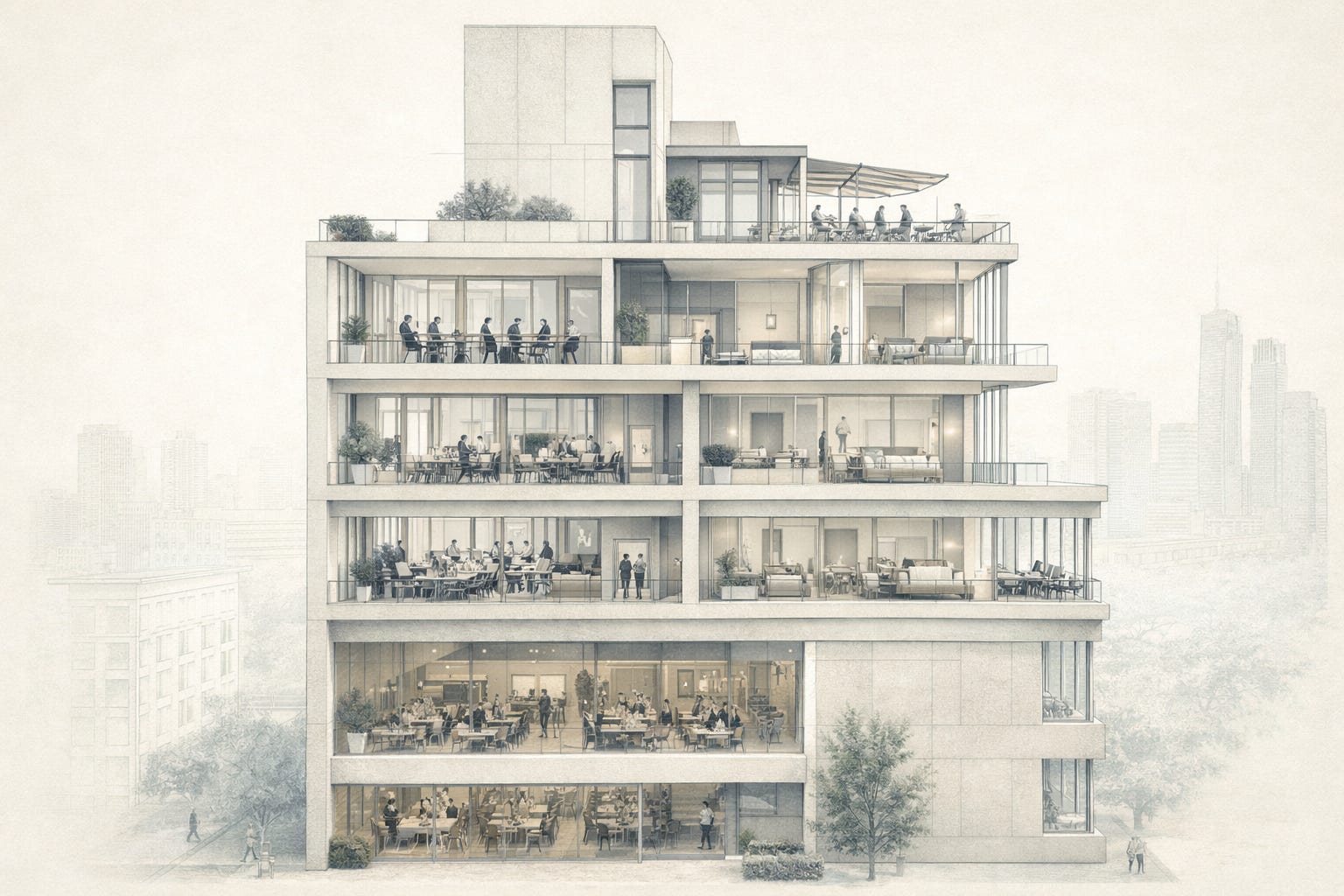
Where Investor Returns on Mixed-Use Developments Take Shape
In the design decisions that turn a building into a destination
When people assess a mixed-use development, the conversation usually starts with the mix:
Office, hotel, food and beverage, wellness, amenity, members club.
Those uses matter, of course.
But in my experience, investor returns start taking shape earlier than that, in the decisions that determine how those uses fit together within the building.
That came into focus for me again on a recent design call. On the surface, the discussion was technical: lifts, circulation, daylight, views, ceiling heights, floorplate efficiency, guest flow, member access. Underneath all of it was a more important commercial question:
How do you plan the building in a way that helps the whole asset perform better?
That is where the economics of mixed-use really begin.
Returns in mixed-use come from creating a destination people want to visit, one that feels intuitive to move through, energised in the right places, and strong enough in experience to pull people back again and again. That is what drives footfall, dwell time, repeat visitation, pricing power, and stronger asset performance over time.
Investor returns start taking shape in the design decisions that determine how uses fit together within the building.
Mixed-use returns are shaped before the model is finished
This is where mixed-use is still too often misunderstood.
A lot of schemes are approached as a scheduling exercise. Allocate the uses. Build the area schedule. Forecast the rents. Model the income streams. Yet mixed-use outperformance rarely comes from the schedule alone. It comes from the quality of interaction between uses, and from whether the building feels coherent as a place.
That is why design planning matters so much.
The way a building is organised shapes the experience from the moment someone arrives. It determines what feels public and what feels private. It influences what draws people in, what encourages them to stay, and what makes the building feel active rather than fragmented. It affects whether movement through the asset feels seamless or awkward, natural or forced.
In a hospitality-led mixed-use building,
that experience sits at the centre of the commercial model.
If the arrival experience is weak, if circulation is clumsy, if the most valuable uses sit in the wrong parts of the building, or if operational friction undermines the experience, the asset becomes harder to activate, harder to differentiate, and harder to monetise at the level it should.
That is why I think investors need to pay much closer attention to the early spatial decisions that shape the asset, long before the scheme is too far advanced.
The building has to work as a system
Take vertical circulation as one example.
Lift strategy is often treated as a technical workstream. In reality, it has direct commercial consequences. It affects how different users move through the building, how much friction they experience, how much crossover exists between audiences, and how much usable area is either recovered or lost. It influences waiting times, access control, floorplate efficiency, and ultimately the overall quality of the experience.
The same is true of servicing, core layout, and floorplate planning.
These are often discussed as design or operational matters. In mixed-use, they shape value creation directly. If one use compromises the experience, efficiency, or economics of another, the impact shows up in performance.
This is why I increasingly see these decisions as part of the investment strategy. They shape how the asset functions day to day, how different audiences experience it, and how effectively the building converts design intent into commercial performance.
Different uses create value in different ways
The same logic applies to where different uses sit within the building.
Not every use creates value in the same way. Some benefit disproportionately from light, views, and a greater sense of volume. Others derive more value from visibility, convenience, ease of servicing, or proximity to the ground floor. Some uses need to sit close to the energy of the building. Others perform better with a degree of separation, privacy, or elevation. Some create destination pull for the whole asset. Others monetise calm, exclusivity, or efficiency.
Treating all uses as spatially interchangeable is one of the fastest ways to weaken a mixed-use scheme.
A flexible workplace may justify better daylight and stronger volume if those qualities translate into stronger demand and better pricing. A hospitality or food and beverage use may deserve a more prominent position if it increases activation, extends dwell time, and strengthens the overall magnetism of the asset. Shared amenities may be most valuable when they encourage crossover without disrupting the operational clarity of the building.
These are decisions that shape how value is created and distributed across the asset.
The best mixed-use developments succeed when the uses have been planned in a way that strengthens the logic of the whole building. They create momentum, energy, and a clear sense of place, while preserving operational clarity.
Returns in mixed-use begin to take shape when a building starts to function as a destination, not just a collection of uses.
Destination is what turns design into returns
That balance matters. In mixed-use, the goal is selective integration. You want enough interaction to create vibrancy, destination appeal, and cross-pollination between uses. At the same time, you need enough separation to protect experience, manage access, support servicing, and preserve the economics of each component.
That is a much harder discipline than simply assembling a mix of uses.
It requires seeing the building as a system.
This is also where I think some investors still get mixed-use wrong. They focus heavily on inclusion, what uses are in the scheme, while spending less time on interaction, how those uses actually work together spatially, operationally, and commercially.
Inclusion alone rarely creates outperformance.
Interaction does.
A hotel above a workplace above a restaurant does not automatically become a destination. A members club beside flexible office space does not automatically create community. A rooftop venue does not automatically create pricing power. Those outcomes depend on whether the building has been planned in a way that makes each use stronger because of the others around it.
That is the real challenge.
It means asking better questions much earlier. Which uses deserve the best light? Which uses should capture the strongest views? Which uses need immediate access? Which should anchor the ground floor? Where should energy build during the day, and where should it build in the evening? Where should public and private uses overlap, and where should they remain distinct?
Those are design questions.
They also shape investment outcomes.
Because returns in mixed-use begin to take shape when a building starts to function as a destination, not just a collection of uses.
And that happens in the early design decisions that define how the whole asset comes together.
That is where mixed-use stops being a concept and starts becoming an investment case.
Caleb Parker is the CEO of Brave Corporation, an operational real estate platform repositioning underutilized office assets through hospitality-led strategies.


