


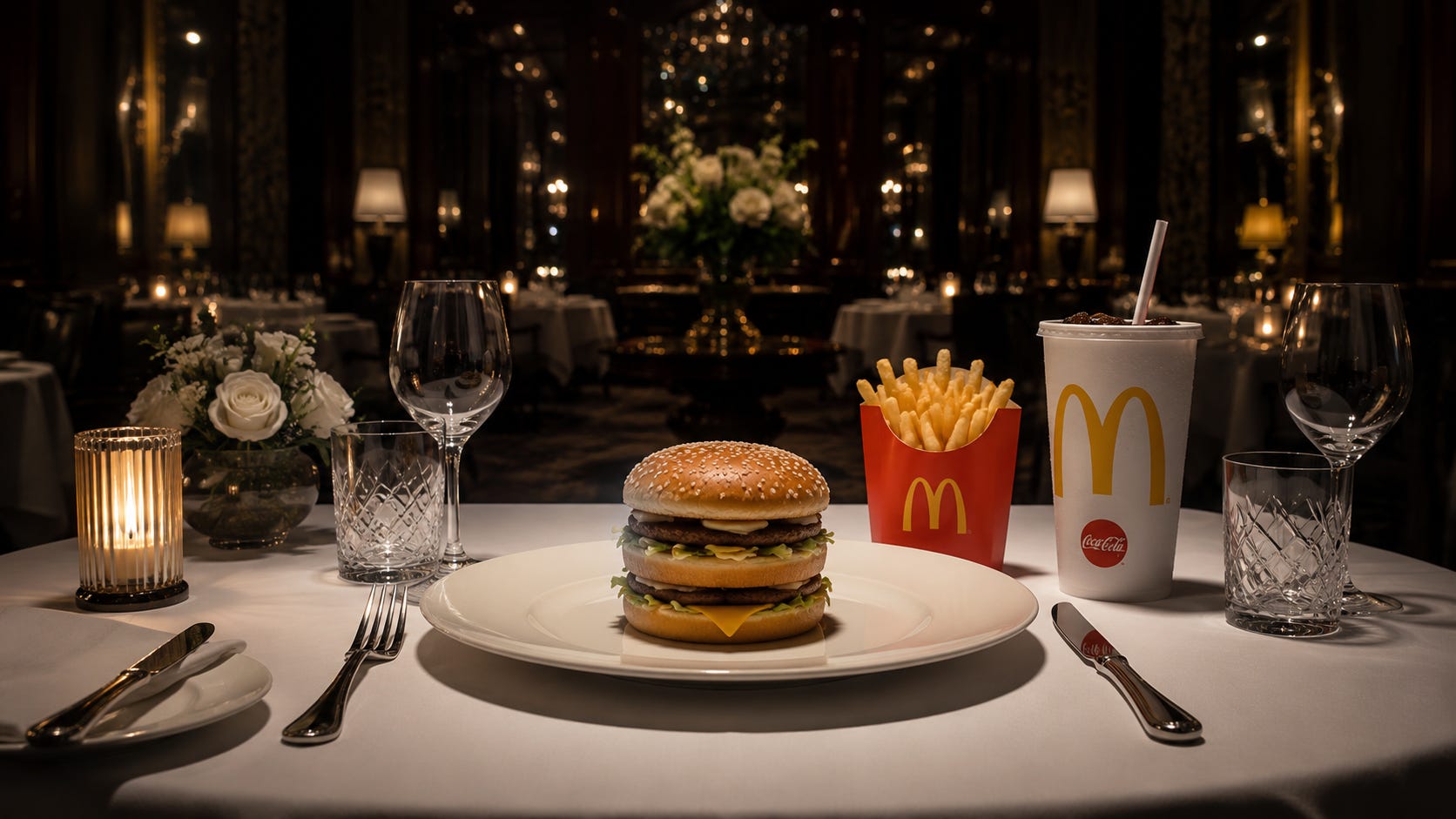
Manchester does not go quietly to bed.
On the corner of Oxford Street and Portland Street, McDonald’s has spent decades feeding whatever the city sends through its doors. Buses grind past the windows. The air inside is thick with hot oil, salt, wet pavement and Coca-Cola syrup. Order numbers are shouted into the noise as the next crowd pushes in behind the last.
In my student days, you did not exactly decide to go there.
You ended up there.
It was the final staging post between the night you had planned and the morning you were now going to have.
It has a doorman.
Is that just a UK thing?
It is loud, brightly lit and mostly unlovely.
It may also understand hospitality better than half the luxury hotels we keep trying to imitate.
Order a Coca-Cola.
It arrives in a waxed paper cup with a plastic lid, packed with ice and sweating gently onto the tray. Push the straw through the cross in the top and take a drink.
It tastes exactly like McDonald’s Coke.
Not good Coke. Not bad Coke. McDonald’s Coke.
It is colder, sharper and somehow more aggressive than the stuff that comes out of a bottle at home. Even people who rarely drink it seem to know this. There are articles, Reddit threads and half-serious theories devoted to why it tastes better beneath the Golden Arches.
The answer is disappointingly practical.
McDonald’s filters the water. It pre-chills both the water and the Coca-Cola syrup before they enter the dispenser. The fountain system is kept cold, and the mixture is calibrated to account for the ice that will eventually melt into the drink.
Then there is the straw.
It is slightly wider than a typical straw, allowing more Coke to hit your taste buds with each sip.
Somebody actually thought about the diameter of the straw.
Not the colour.
Not whether it looked premium.
Not whether a customer might photograph it and tag the brand.
Somebody considered what would happen inside your mouth when you took a drink and altered a piece of disposable plastic accordingly.
You were never supposed to notice.
There is no little card beside the dispenser explaining the filtered water. The person behind the counter does not tell you that the syrup was pre-chilled for your enjoyment. Nobody points out the engineering of the straw as they place it on the tray.
You drink the Coke and think it tastes good.
That is the whole transaction.
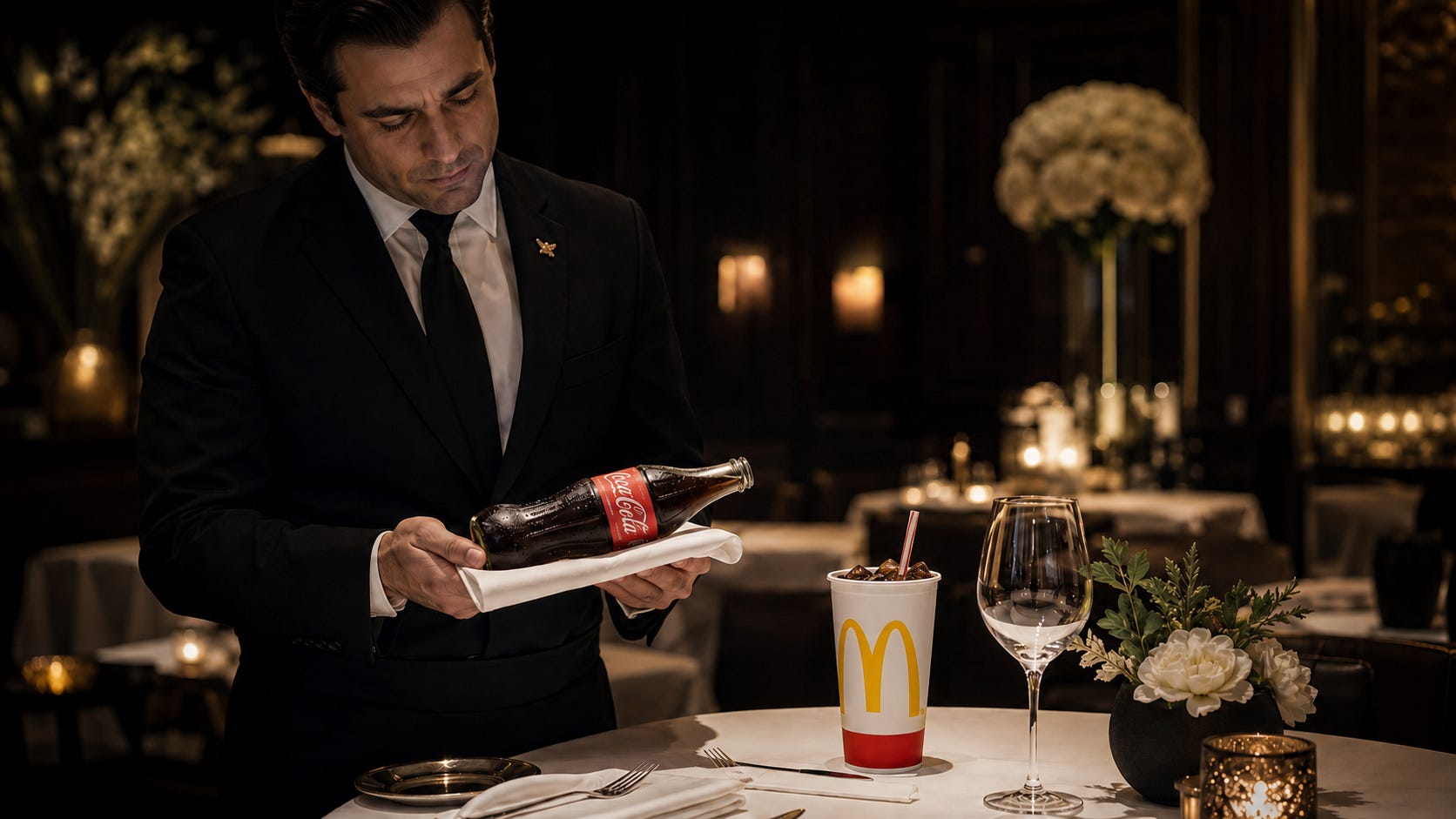
McDonald’s is an odd place to look for lessons in hospitality.
It has none of the usual credentials. There is no concierge, no maître d’, no lobby scented with cedarwood and bergamot. Nobody is going to remember which side of the bed you prefer or arrange for your favourite bottle of wine to be waiting when you arrive.
There is usually at least one machine making an unpleasant beeping sound.
And yet, behind that counter, an extraordinary amount of thought has gone into ensuring that you receive the Coke you expected.
Flex offices rarely talk about this kind of hospitality.
We prefer hotels. The expensive ones, naturally. We pass around stories about unreasonable hospitality, handwritten notes and extravagant gestures. We visit private members’ clubs, take photographs of the furniture and return convinced that the answer is softer lighting and better soap.
There is nothing wrong with any of that.
A beautiful room can make people feel good.
A thoughtful gesture can rescue a miserable day.
But those are the visible parts. They are also the easiest parts to copy.
The harder work is deciding what the Coke should taste like, then building an operation capable of making it taste that way thousands of times a day.
The five minute fry
McDonald’s applies the same cold logic to its fries.
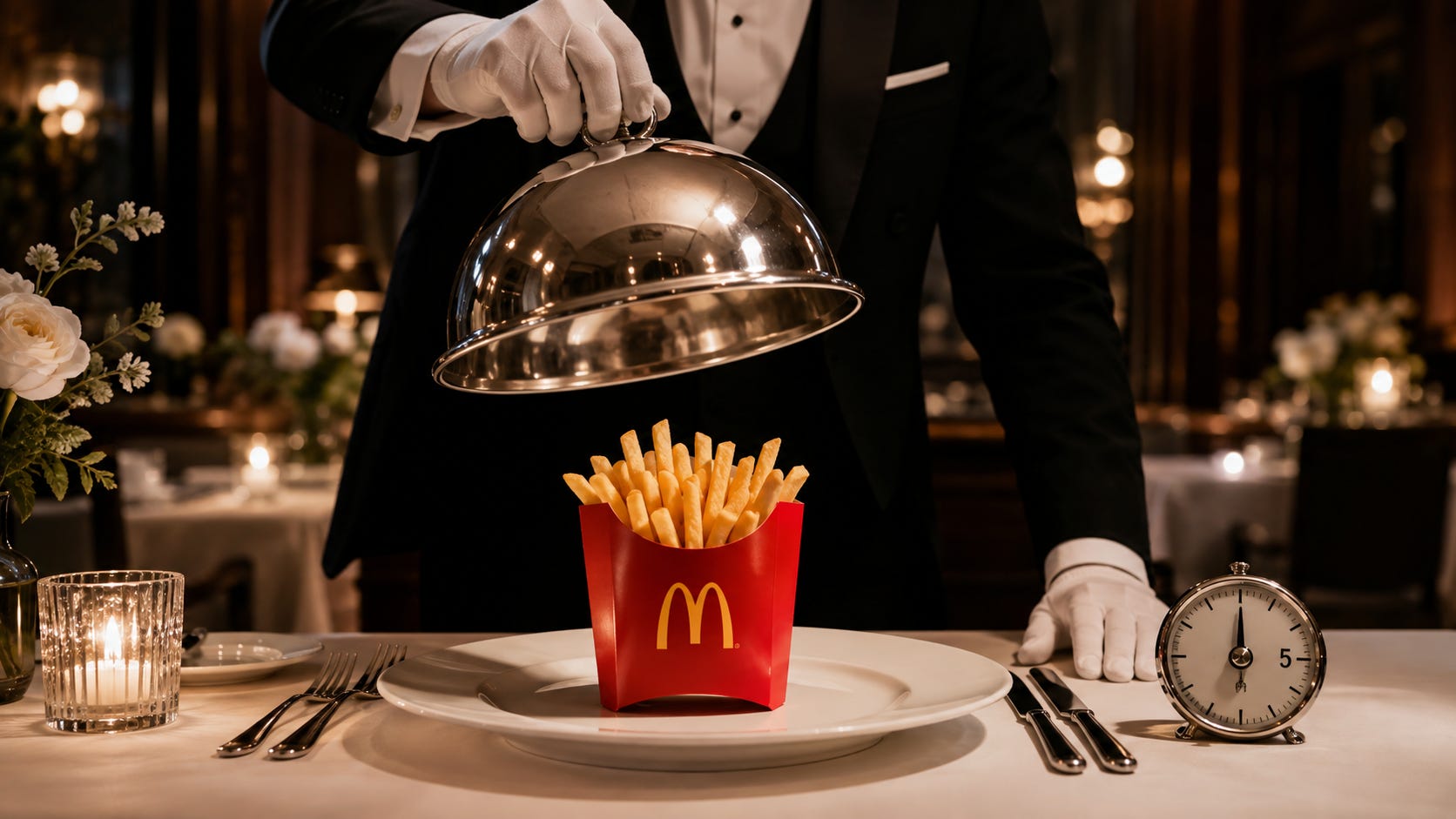
Cooked fries should only be held for up to five minutes. After that, they may still be warm. They are almost certainly still edible. A hungry person would probably eat them without complaint.
But they are no longer the fries McDonald’s intended to sell.
That is a more demanding standard than it first appears. It does not ask whether the product can still be handed over. It asks whether the product is still right.
Flex office hands over a lot of five-minute-old fries.
The meeting room is available, although the table is still carrying the rings from yesterday’s coffee cups. The screen works, provided somebody knows which loose cable to wiggle. The day office is ready, if ready means there is a desk inside it. The enquiry has been answered, although it spent two days ageing gently in a shared inbox first.
Nothing is completely broken. Everything is technically usable. The customer gets what they bought, more or less.
We have become very comfortable with more or less.
Weighing the bag
McDonald’s is now going further.
Across thousands of restaurants, it has introduced scales that weigh outgoing orders. The system knows roughly what the completed order should weigh. If the bag is too light, it warns the team that something may be missing.
There is something wonderfully blunt about that.
The business does not wait for a customer to arrive home, open the bag and discover the absent fries. It does not email them the following morning asking how likely they are to recommend the collection experience.
It weighs the bag.
The mistake is still allowed to happen. Human beings are involved, so mistakes always will. The clever part is that McDonald’s has built the failure into the operation and placed a tripwire before it reaches the customer.
Most flex businesses install the tripwire afterwards.
It is called a complaint.
Hospitality without the hero
This is where our view of hospitality has become confused.
We treat it as a quality possessed by particularly warm people. Hire somebody friendly, give them permission to perform the occasional small miracle and hope they are working when something goes wrong.
When they are, the business feels wonderful.
They remember the member’s name, find the missing adapter, rearrange the room and somehow get lunch delivered before the meeting starts.
When they leave, much of the hospitality leaves with them.
McDonald’s does not depend on every employee being a magician. Somewhere, at this exact moment, an exhausted eighteen-year-old is halfway through a Saturday night shift, surrounded by delivery orders and machinery that will not stop beeping. The Coke still has to taste like McDonald’s Coke.
The water is filtered whether the manager is charming or not. The syrup is cold on a bad shift. The straw remains the same width when the restaurant is busy.
That is the real achievement.
McDonald’s has built an operation in which an eighteen-year-old on their first week can deliver a more consistent product than many businesses manage with experienced teams, lengthy service manuals and three layers of management.
That is not soulless standardisation.
It is respect for the customer’s time, money and expectations.
Real hospitality is often invisible.
It happens before anybody walks through the door.
It lives in holding times, temperature controls, correctly weighted bags and a fractionally wider straw.
The customer does not need to see the effort.
They should not have to.
They should simply take a drink and know it tastes right.
Perhaps flex office does not need another lesson from a five-star hotel.
Perhaps it needs to spend a little more time beneath the fluorescent lights, listening to the fryers beep, thinking about the straw.