
The Flex Divide: Regional Realities in a Brave Economy
Part 3 of 4 · Q3 Rubberdesk Report: Flex Is the Backbone of the Brave Economy
In our first article, we looked at how businesses are embracing flexibility to navigate uncertainty and, in turn, creating what we call the brave economy. But resilience does not look the same everywhere. Across the UK, flex space trends vary massively, and these trends can be used to give us insight, reflecting local confidence and strategy.
So, let us take a closer look at how different cities are responding, and what that says about the brave economy as a whole.
London: Premium vs practicality
With 80% of the available Flex space in the UK (6.23m SqFt of 7.75m SqFt), London remains the epicentre of the UK flex market, but it is beginning to split in two.
On the one hand, we have Managed Offices.
These are premium, customised spaces often used by enterprise clients, and they are booming. Rates jumped 4.8% to £828 per desk, while availability fell 11%.
Big businesses are doubling down on quality and flexibility to attract talent and future-proof operations as they face uncertainty. These spaces now command a 40% premium over standard offerings.
Then we have Serviced Offices.
These are arguably the more economical, all-inclusive option, and they tell a different story. Rates dipped slightly by 0.5% to £590, making them a haven for companies under cost pressure. Predictability and simplicity clearly matter when things feel squeezed.
When we look closer at the flex market by office size, the friction points between Serviced and Managed offices become clear.
For teams of 1–15 staff, Serviced Office operators remain the undisputed choice. But the landscape shifts as headcount rises. While Managed options surface at the 16-person mark, it is in the 26–50 and 50+ segments that they truly fight for occupier attention.

So where has all the Managed Office capacity come from?
Managed Offices are not cannibalising the Serviced Office sector;
they are a dynamic new product emerging from the ashes of legacy leases.
Offering the same rapid turnaround as the Serviced Office market, managed workspaces directly address the occupier’s demand for customised, service-led environments. It is a solution that prioritises flexibility, allowing occupiers to step away from the distractions of space management and focus entirely on their business.
Birmingham vs Manchester: Caution or confidence?
Now, compare that to Birmingham.
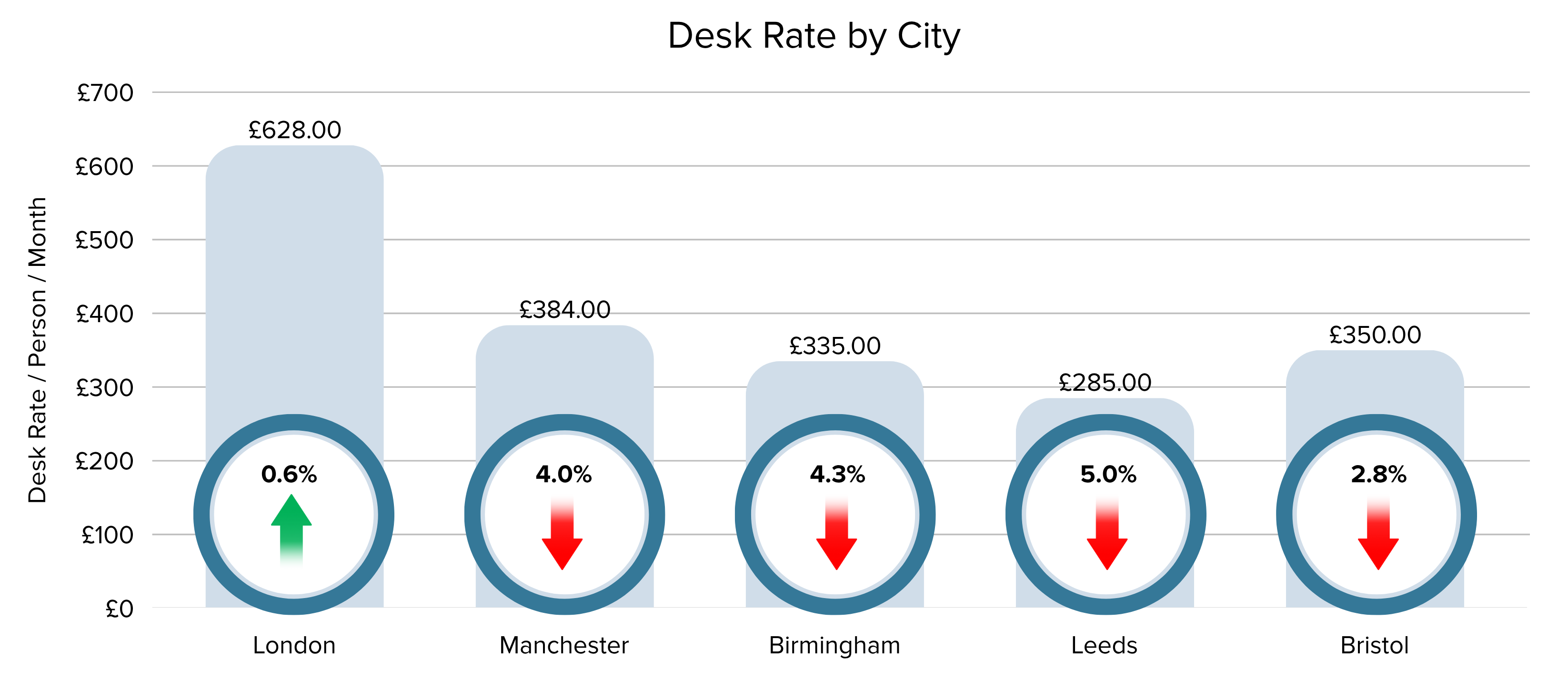
Here, we are seeing more caution. Availability rose 9%, and rates dropped 4.3% as many companies hit pause ahead of the November budget.
Is restraint a weakness?
Or can waiting for clarity be as strategic as expansion?
In Manchester, on the other hand, rates dipped 4% to £384 per desk, but availability also fell 7%, driven by strong uptake.
Businesses here are leaning into growth despite uncertainty.
The divergence in confidence looks even starker when we go beyond citywide numbers and dive into the different office segments.
Nowhere is this clearer than in the enterprise sector:
While Birmingham’s large corporate inventory rose 16%, Manchester saw a 12% contraction in 50+ desk spaces, pushing rates up 4.4% to £425 per desk.
At the small end of town, availability for 1–4 and 5–10 desk suites in Birmingham surged 21%, signalling that smaller occupiers are shedding space or delaying decisions.
In contrast, Manchester’s dynamic market saw just a 1% increase in availability across these same two segments.
Bristol vs Leeds: Too much, too little
Then there is Bristol, where office availability surged by 42%, driven mainly by an increase in small office spaces. With this growth, average rates slipped by 2.8%.
This raises a key question:
Are operators expanding faster than demand?
If so, oversupply could put pressure on margins and profitability.
Leeds, on the other hand, saw the opposite trend.
Rates fell 5% despite there being 12% less available space.
Here we see more competitive pricing strategies, likely to attract tenants, even as the market shrinks.
But what does this all mean?
Regional differences show that the brave economy is built on adaptability and resilience. Each city has its own rhythm, shaped by local culture, economic conditions, and demand patterns.
This means businesses cannot rely on a single formula.
Instead, they need to stay flexible and responsive.
For operators, the takeaway is clear:
Pay attention to local signals and adjust strategies for each market.
What succeeds in one city might not work in another.
It is about being agile, customising solutions, and learning quickly from what works in each market.
Published exclusively in partnership with early access to Rubberdesk’s Q3 2025 report.


