


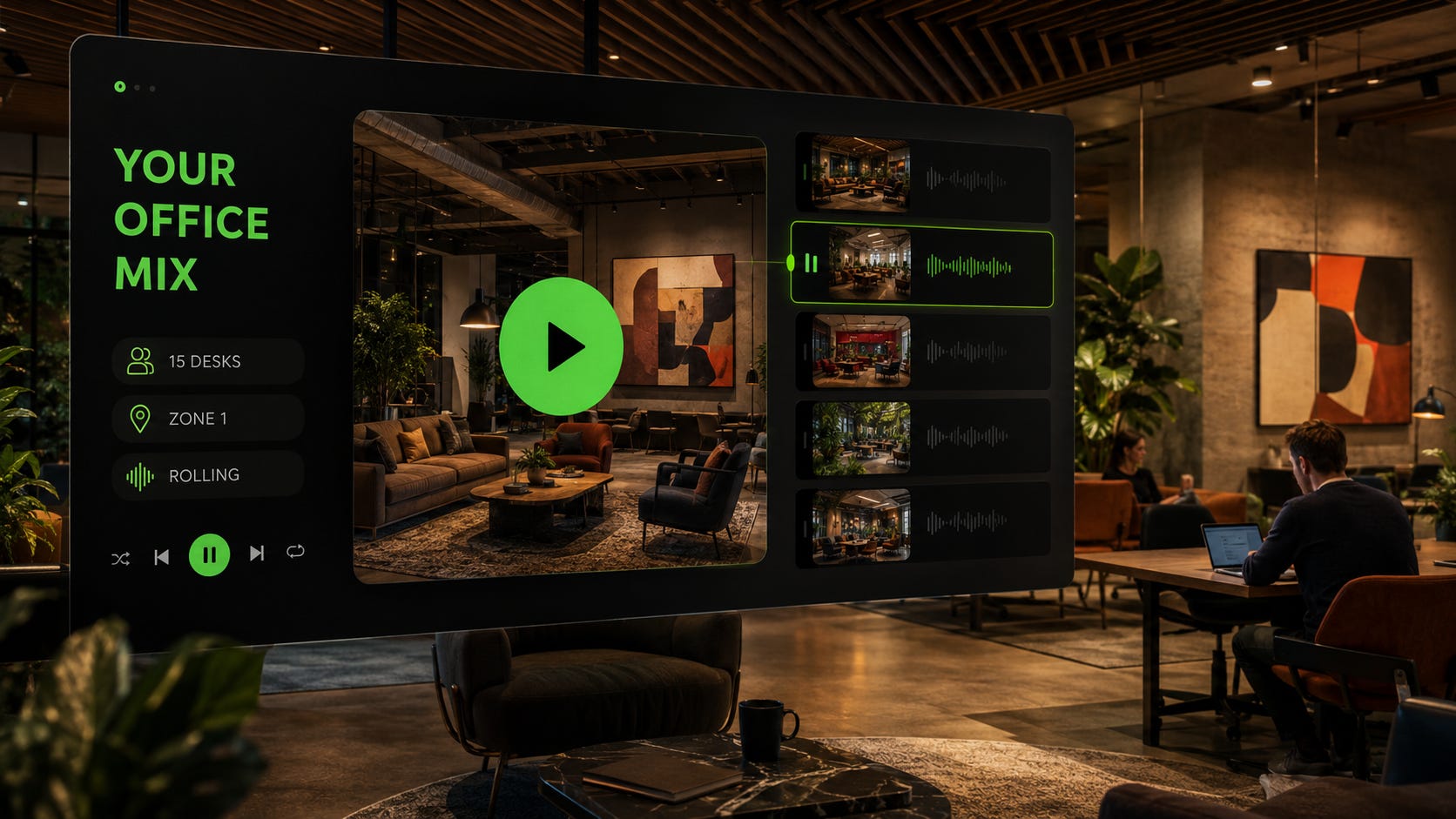
Consumer personalisation is largely driven by repeated behavioural signals. Look at Spotify - it “guesses” your mood from your recent songs and rolls into the next track. Based on your watching habits, Netflix suggests a film you’ll enjoy that you never even knew existed. The clever part of this isn’t the recommendation. It’s how little of it depends on you telling it anything.
But decisions and purchases in business, like finding a new workspace, do not work that way. A company might only take an office every three to five years. There’s no behavioural history to look at because there’s no behaviour to go on. Just one decision to make under conditions that will have certainly changed since the last one.
So personalisation in workspace sourcing must ask questions.
And most importantly: which questions you ask, and in what order.
“But I have an enquiry form!”
Most workspace enquiry forms will collect three data points:
how many desks, location and how long for.
Pretty reasonable.
But also close to useless for working out how well a space will suit.
Take two identical briefs landing in your inbox:
fifteen desks, Zone 1, rolling contract.
One is a legal practice.
That team needs rooms where confidential calls don’t happen behind glass, and a reception that reads as serious to visiting clients, and probably a floor they don’t share with a gym.
The other is a product design studio, which needs wall space it’s allowed to ruin.
Same form, same three fields, completely different outcomes.
What good brokers do
I’ve watched what numerous experienced brokers do with a brief. And maybe no surprise; they rarely start with desk count.
They will ask what the fifteen is based on.
Is it a ceiling or an aspiration.
Who’s signing off.
What didn’t work for them in their last space.
Do clients ever visit, and what the firm wants them to think when they walk in.
None of that is what the enquirer tapped into the form.
But it was made a part of the conversation because the broker has had this conversation two hundred times before and knows which threads to pull.
The order also matters just as much as content:
Ask about growth before term and you tend to get a fuller brief;
Ask term first and the conversation narrows before it’s begun.
Ask about budget first and you’ve capped the conversation before you understand it.
Very little of this is written down anywhere, and brokers don’t always find it easy to explain how they do it.
But two things are working at once here:
Guided asking: where different occupier types need different questions and experience tells you which.
Inference from outcome: where firms of a certain profile have consistently needed something they didn’t specify, so you raise it before they do.
Ask the structured questions without the pattern knowledge behind them and all you’ve done is make the form longer.
Enter the AI era
Software can hold these patterns at a volume no individual can match.
That’s a strong argument for AI.
A model with enough structured briefs and outcomes can learn which questions predict “fit” for which occupier type. Dependent on the occupier, this might be optimised for shortlist acceptance, viewings booked, deal completion, satisfaction or likelihood of renewal or contract extension.
But the all-too-common “AI-powered personalisation” is doing a lot of unexamined work in marketing copy.
An interesting benchmark called Know Me, Respond to Me examined how models use changing user information across simulated interaction histories. Frontier models recalled user facts reasonably well (60–70%), yet performed considerably worse when incorporating a user’s current situation into their responses (30–50%). The benchmark did not test workplace sourcing, so its findings cannot be applied directly to this market. They do, however, demonstrate the limitations of relying on loose context to produce reliable personalisation.
And the uncomfortable one.
Researchers at MIT and Penn State found that interaction context increased agreeableness in four of the five LLMs they studied, with condensed user profiles producing the largest effect.
Anyone using these tools today has hit the “You’re absolutely right” moment. Which is a problem here, because a system that agrees with the brief will never surface the requirement the occupier didn’t state, and the value of a good broker is that at some point they say, gently, that what you’ve asked for isn’t what you need.
Relationships aren’t data collection, as any experienced agent will tell you.
Trust, reading a room, knowing what a pause means; none of that goes in a form. And even if it could, I’m not suggesting it does. What I’m describing sits alongside the relationship: pattern knowledge that used to live in one head, made available earlier, so conversations can start from a better place.
Why this goes against how much of this market is being built
The flex and managed sector has spent a decade solving supply:
more operators, a wider spread of buildings and product types, and better listing data (sometimes) than we’ve ever had before. The assumption underneath all of this is that more options produce better outcomes for occupiers.
I don’t think that’s right.
A vague brief doesn’t sharpen against a bigger database.
It just misses more times.
Filters scale with the market. They don’t get smarter as it grows.
That’s the structural problem with competing on database breadth.
Adding another filter field hands the work back to the occupier at exactly the moment their decision got harder.
Scarcity has moved.
The hard part now is knowing which questions cut the list down before anyone opens a floorplan.
My bet is that the centre of gravity will move.
For many years the advantage has belonged to whoever held the biggest list. Increasingly I think it belongs to whoever asks the best questions. The growth in supply is driving that, not slowing it down.
When you’re assessing a platform that sells personalisation, ask whether it ever tells a customer they’re wrong. If it only ever agrees, it’s a filter with better manners.
Your enquiry form was never going to tell you whether a space is right for a client. That work is happening somewhere else, in conversations you don’t see.