


I keep coming back to one question…
How many secondary offices are really prime assets trapped inside an obsolete product?
European office take-up fell 6% during the first half of 2026 and remains 3% below the five-year average, according to Savills’ latest European Office Leasing report.
But the detail beneath that headline is more interesting.
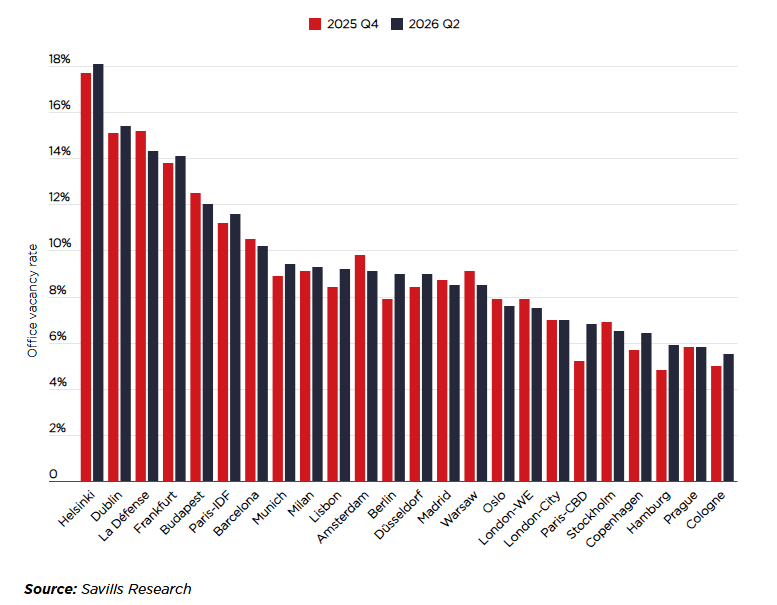
Average office vacancy across Europe is 9.4%.
Prime CBD vacancy is approximately 2%.
Prime rents increased by 3.7% over the past year.
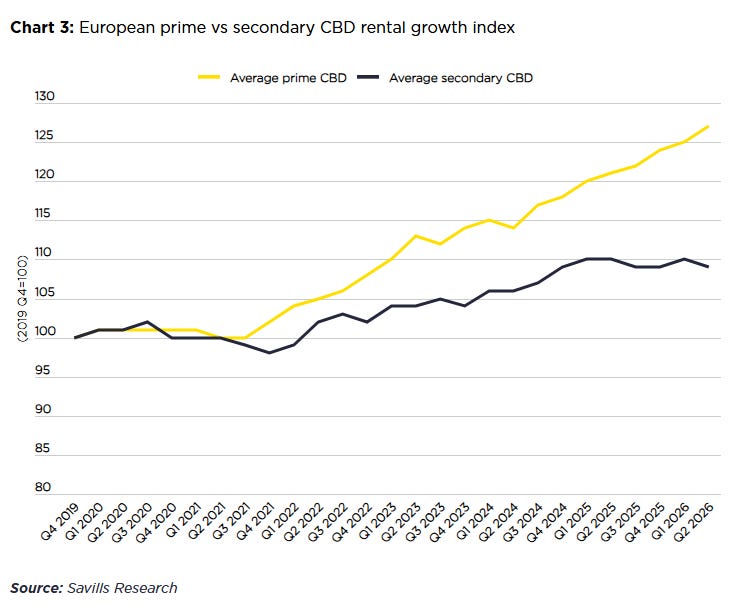
Since 2019, average prime rents have increased by 27%.
Secondary CBD rents have grown by 9%.
Demand has become selective.
Companies still want offices.
They just have higher expectations around location, quality, sustainability and the experience their people have when they get there.
The quality gap is visible across the UK
The regional data tells a similar story.
JLL reported overall vacancy of 10.9% in Manchester during Q2 2026.
New-build vacancy was only 1.2%, its lowest level since 2020.
Prime rents increased from £45 to £48 per SqFt during the quarter.
JLL recorded Grade A vacancy of 2.7% in Edinburgh, 2.1% in Leeds and 1.9% in Glasgow.
There is plenty of office space still available.
But supply of offices companies actively want is much tighter.
That creates interesting questions for investors:
Do you buy the prime building at a price that reflects its success?
Or do you acquire the overlooked building and create the product the market is demanding?
Can you create prime?
We tend to treat prime and secondary as permanent labels.
But buildings evolve.
And so should the expectations placed on them.
A well-located building can fall behind because its design, services, amenities, technology or identity no longer reflect what companies and their people value.
This creates the potential for repositioning.
One finding in the recent Savills research stood out to me.
Using a self-financed, 12-month refurbishment model that includes the rent forgone during the work, Savills estimates that the payback period for turning a secondary City of London office into a prime product has fallen from ten years to five.
Savills also reports that prime rents in the City of London have increased by 49% since 2019, while secondary rents have fallen by 19%.
They describe this as evidence of a more visible “brown discount”.
The market is penalising buildings that have failed to keep pace.
Of course, each building still needs to work on its own merits.
The location needs to support demand.
The structure and floorplates need to be viable.
The acquisition price, CapEx, financing costs and achievable revenue absolutely need to leave enough room for a return.
Manchester also has 1.07 million SqFt under construction, all of it speculative. Today’s shortage of new space may change as that pipeline completes.
City-wide statistics can point us in a direction.
But they cannot replace asset-level underwriting.
Flexibility is becoming part of premium
The premium office also needs to respond to how companies are making decisions.
JLL’s Future of Work research surveyed 2,200 executives and corporate real estate leaders across 21 countries.
It found that 78% expect AI to affect their portfolio strategy significantly during the next three to five years. Only 15% are actively transforming their operations today.
Some 40% identified uncertainty about AI’s impact on their space requirements as a portfolio risk.
JLL also found that innovation-intensive businesses are moving towards planning horizons of 12 to 24 months. Many property decisions continue to rely on assumptions extending seven to ten years.
Businesses need room to adapt as their headcount, attendance patterns and operating models change.
Savills found that flexible offices still account for only 3% of European office take-up, unchanged from last year.
That 3% raises a question.
If businesses need greater flexibility, prime space is scarce and plug-and-play demand is growing, why has flex remained such a small part of measured take-up?
It could reflect the way flex transactions are recorded.
It could also point to limitations in the products, locations and operating models currently available.
The data cannot answer that yet.
A better product needs a better operating model
Premium is often discussed through the lens of specification.
I believe the definition is expanding.
A premium workplace should provide flexibility around how people commit to and use space.
It should make people feel looked after.
It should create reasons for people to connect, collaborate and return.
It should have an identity capable of changing how the market perceives the building.
That requires more than a refurbishment.
It requires Design-led Space, Technology, Community, Hospitality, Management and Brand working together as one operating proposition.
This is what I call the Full-Stack Office.
It is also the thinking behind Brave Corp’s Members Clubs for Lifestyle Working™.
We are building a model for acquiring and repositioning existing buildings around the way people want to work and companies need to operate today.
The Savills and JLL data do not prove that hospitality, amenities or brand caused the rental growth recorded across prime offices.
But they show us where demand is concentrating.
Our thesis is that a Full-Stack Office strategy can help the right secondary asset compete for that demand.
Some secondary buildings will always remain secondary.
Their location, structure or economics will limit what can realistically be achieved.
Others may be suffering from an outdated product and operating model.
Our question remains:
How many overlooked office buildings are waiting for someone to create the next generation of prime?