



I speak to workspace operators who will happily tell me what they dislike about their software. They know which reports they cannot trust, which tasks take too long and which spreadsheet keeps the whole thing running. They would like something better.
Yet they still plan to renew.
I find that frustrating.
I also understand it.
Changing systems means moving data, retraining people and risking disruption in a business that still has to open its doors tomorrow morning. The fear of discovering on Monday morning that contracts are missing or invoices are wrong prevails.
The difficulty is that the disruption of change is easy to imagine.
The cost of carrying on is already absorbed into the working day.
A community manager spends an hour reconciling records, finance checks the same contract again, and everyone calls it normal.
The work between the systems

Picture a Monday morning:
Management asks how a building is doing against budget.
Sales opens the CRM.
The community manager has occupancy in a spreadsheet updated on Friday.
Finance has invoices in the accounting system and another spreadsheet matching them to contracts.
An hour later, there are three answers that almost agree.
Each tool may be doing its own job perfectly well.
The problem is what happens between them.
This is where the workarounds appear. A salesperson sends a quote outside the CRM because it is quicker. A manager keeps a separate availability sheet because they trust it. Finance asks for the signed contract again.
The team becomes the integration.
Before asking people to follow the process more carefully,
I would ask why the process makes them do this much work.
A shortcut can tell you exactly where the official system has stopped helping. It can also become a problem if the next person never records the information they need.
AI still needs a reliable business record
The tempting response is to leave the systems in place, aggregate their data and put AI over the top.
But take a quote sent by email and never recorded in the pipeline.
Bringing the recorded data together leaves that gap in place. An AI tool may help spot a discrepancy. Unless it also helps correct the record or changes how the work gets captured, someone still has to investigate and repair it.
Show me what happens differently after the answer appears.
Does the team avoid entering the same information again?
Start with the business decision
Technology has a cost.
Of course it belongs in the budget. But the subscription tells you very little about whether the business is getting value from it.
I would judge it against three practical measures.
Time to cash
Follow the deal from the first enquiry to money in the bank. How long does it wait for a quote, approval or contract? Once signed, how quickly is the correct invoice issued and paid? Measure the delays you can remove, allowing for the customer’s planned start date. A faster signature alone does not bring forward revenue.Time to sell
How much of your team’s week is actually available for prospects and members? Removing unnecessary admin gives the team capacity to respond sooner and spend more time with customers. Measure the hours returned, then look at what changes in response times, conversion and retention.Time to decide
How quickly can the owner get a reliable answer to a commercial question? Before approving a discount, they should see the price, concessions and availability. Measure the time it takes to get an answer people trust, and whether it arrives before the decision is made.
Put a rough number on the work around it.
Say three people each spend three hours a week on double entry, chasing missing information and reconciling spreadsheets. At a fully loaded cost of £25 an hour, across 48 working weeks, that is £10,800 a year. The assumptions are illustrative. Run your own.
That time is already on the payroll.
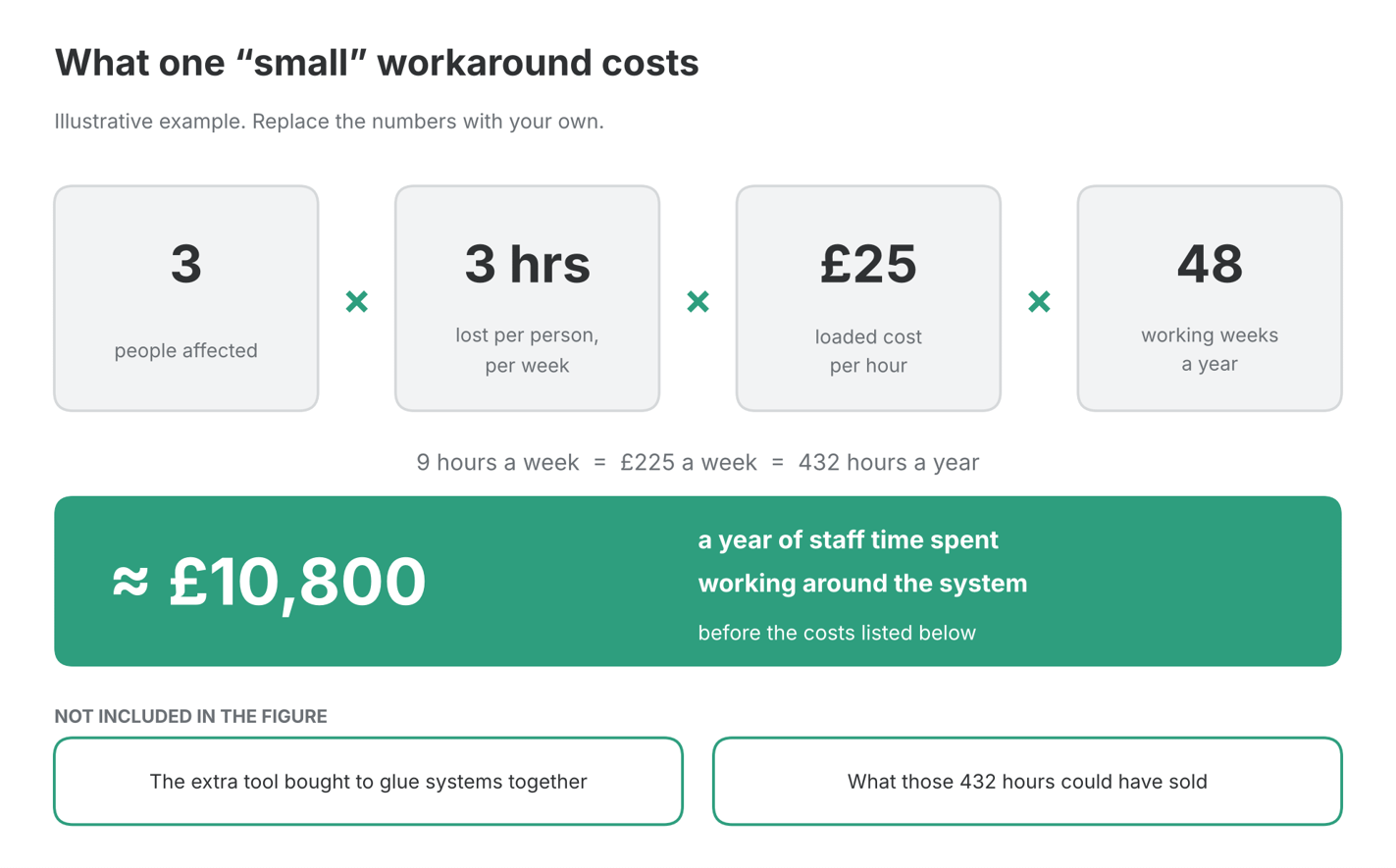
This calculation puts a value on time.
Turning that into a financial return depends on what the business does with the capacity released: improving service, supporting more sales or avoiding additional hiring. The cost of the change belongs in that calculation too.
Sometimes the fix is a better integration.
Sometimes it is removing an approval or agreeing who owns a record.
Sometimes the current software cannot support the way the business needs to operate, and replacing it deserves serious consideration.
Where to start
You do not need a new platform to start.
Five questions will tell you where to look:
Where does your process get skipped?
Ask the people on the front line which steps they leave out and why. Watch a real deal move through the business. Note where people retype information or keep a separate record, and how much time that takes.Where does an enquiry wait before it becomes cash?
Measure the time spent at each stage, from quote and approval through signature, invoicing and payment. Separate internal waiting from the customer’s timing. Find the delays you can remove, and give someone responsibility for removing them.What would your Monday morning look like on one page?
Start with revenue and operating costs against budget, achieved prices after concessions, contracted occupancy and overdue debt by payer. Keep forecasts separate from signed commitments. Agree which records you trust and how this view will stay current.Which decisions need approvals, and with what context?
Set approval limits by contract value or discount, with clear rules for exceptions. Make sure the decision comes with the commercial context. Then let the team proceed with deals inside those limits without waiting for another signature.Which tools exist mainly to bridge the gaps?
Count their licences, the work needed to maintain them and the hours still spent moving or checking information. A useful integration can earn its place. Challenge the arrangements that cost more to run than the work they remove.
Manage it like a margin
When your team works around its software, that is data.
It tells you where the process fails the people who run it.
Put a value on that failure and weigh it against the full cost of fixing it, including migration and training. Keeping the current setup may still be right. It should survive the same scrutiny as replacing it.
A cost line gets trimmed.
A margin gets managed.
