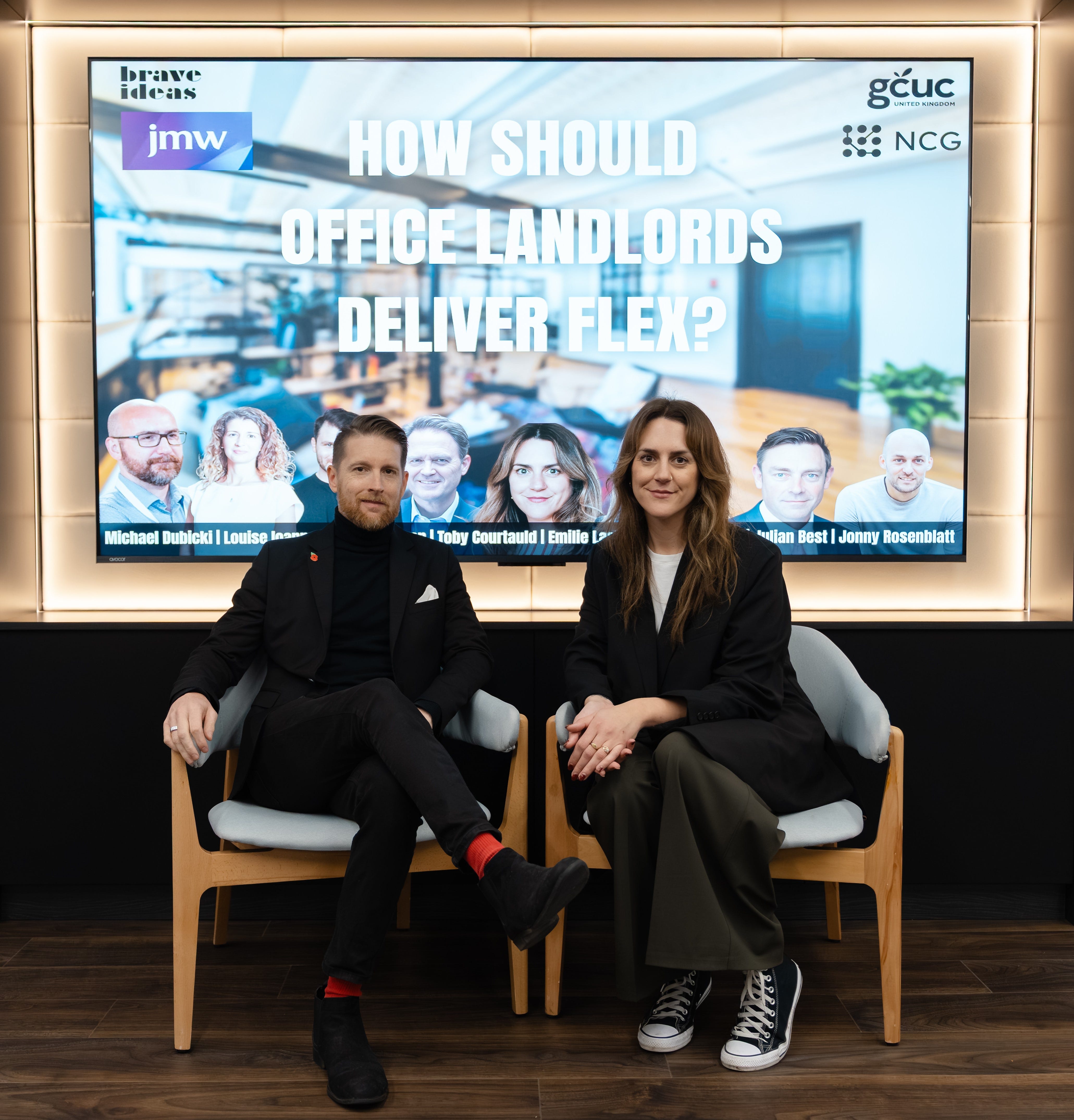
Event Recap: How Should Office Landlords Deliver Flex?
A Brave Ideas x GCUC UK live session on landlord flex strategies, comparing in house platforms with operator partnerships.


On Thursday 27 November 2025, Brave Ideas and GCUC UK brought together office landlords, investors, operators, agents and brokers for a sold out breakfast event at JMW Solicitors LLP in the City of London.
The question on the table was narrow but consequential:
”How should office landlords deliver flex?”
Hosted by Master of Ceremonies Michael Dubicki, Director of Flex Strategy and Growth for NCG, the morning focused on practical routes, not theory.
Two panels, two models, one audience, and an explicit focus on what has worked, what has not, and how flex affects both customers and building performance. The event was supported by NCG and JMW Solicitors.
Panel 1, Landlords delivering flex in house
Zac Goodman, CEO for TSP
Toby Courtauld, CEO for GPE
Louise Ioannou, Head of Workspace for HB Reavis UK
Moderated by Emilie Lashmar, Director & Producer for GCUC-UK
Panel 2, Operator plus landlord partnership
Jonny Rosenblatt, CEO for Spacemade
Julian Best, Property Director for Howard de Walden Estate
Moderated by Lisa Cations, Managing Director for JCR Advisors
Breakfast networking started at 8:30am, Panel 1 ran from 9:00am, Panel 2 from 10:15am, followed by networking to midday. Q&A followed both panels.
Panel 1
When landlords decide to become operators
The first panel approached the core question by asking when the traditional lease model stopped being enough. Emilie organised the conversation into seven sections, from the moment thinking shifted, through customer language and build versus partner decisions, into lessons, community and short term predictions.
Key prompts included:
When did you decide not to outsource flex, but to deliver it yourselves
Was that shift driven more by customer demand or by internal strategy
What did you gain by keeping flex in house, and what did you lose
Who should not try to build it in house, and why
Across the hour, several themes repeated.
Landlord flex is now framed around the customer
Panellists repeatedly described a move from product first thinking to customer first thinking. Instead of starting with units, rent and incentives, the starting point was what customers are actually asking for when they walk in the room, cost certainty, speed to occupation, operational support, and workplaces that help them attract and retain people.
The “Customers vs Industry Speak” section drew a clear distinction between how the industry markets “flex” and the language occupiers actually use. Labels felt secondary to outcomes. The direction of travel was obvious, strategies are being set with customer requirements as the organising principle.
For investors, that change alters what gets funded, with capital moving into service and operations as well as space, not only into fit out and rent free periods.
In house flex suits a specific landlord profile
On the central question, should landlords deliver flex in house or partner, the panel drew an implicit line.
There was broad acknowledgement that in house flex is most viable for landlords who:
Hold scale in their portfolios
Have the budgets to hire, train and support operational teams
Work to long hold business plans on key buildings
In those conditions, landlord flex can be treated as a real operating business sitting above the asset, rather than a side experiment. Structured well, that operating business can contribute to:
NOI growth
Cash on cash returns at building and portfolio level
Market rent levels that can be capitalised once operations stabilise
Crucially, the room recognised that partnership models can achieve the same financial outcomes. The difference is not that one route delivers performance and the other does not, it is where the operating capability sits and who carries the execution risk and overhead.
The point was also made that not many owners have the mix of scale, capital and organisational focus required to build and sustain this capability internally, especially as more landlords enter flex and margins tighten.
Community as a retention mechanism, not an add on
In the “Community and Connection” section, Emilie asked the panel to drop the usual imagery of yoga and beer taps and speak about community in terms of retention, intelligence and brand loyalty.
Community activity was framed as a direct commercial lever rather than a lifestyle extra. One reference that stuck with the audience was the idea that a single renewal can pay for a year of community programming. That puts community on the same page as other retention tools.
The financial logic was clear, empty buildings are expensive, and it is typically more efficient to retain existing customers than to find new ones once vacancy, incentives and reletting costs are accounted for. From that perspective, targeted investment in community that lifts renewal rates becomes part of risk management and revenue protection.
Panellists were candid about missteps, including underestimating the operational intensity of flex and the level of hospitality expertise required. The consistent warning to other landlords was not to treat flex as a light touch bolt on.
Panel 2
A landlord plus operator partnership in practice
Panel 2 turned to a different route, a structured landlord plus operator partnership, using the collaboration between Spacemade and the Howard de Walden Estate as a live case study.
The conversation followed the prepared flow:
The story behind the partnership and how the parties first connected
Why Howard de Walden chose to explore flexible office solutions
Why this opportunity stood out to Spacemade
How the partnership was structured beyond a standard lease
The challenges in bringing the first site to life
How success is being measured today, and what is planned next
The panel referenced Elmtree, three buildings focused on coworking, and Hale House, two buildings centred on health tech, as examples of how the partnership spans multiple assets in the estate.
Three points stood out.
Partnership as a long term value strategy
Julian described the journey from bringing in an operator to stabilise an underperforming unit, to treating flex as part of a broader long term value strategy across the estate. That shift required alignment around operational and financial objectives, and recognition that flex is an ongoing operating commitment.
Jonny outlined how Spacemade tailored its approach within an existing portfolio through a management agreement structure rather than a traditional lease, and how that alignment supports performance over time.
Operator models deepening hospitality and brand
The panel highlighted that operator led models are going further on hospitality, community, vibe and brand on a day to day basis.
Examples included:
Community building and programming that spans multiple buildings in the estate
Clear and consistent brand expression across sites
Vertical expertise, such as the health tech focus at Hale House, with services and programming tailored to a specific ideal customer profile
The implication was not that landlords cannot reach this level, but that building these capabilities in house is resource intensive.
For many owners, partnership with a specialist operator is the more efficient way to bring this depth into their portfolios while still targeting NOI, cash on cash returns and capitalisable rent levels.
Measuring success beyond occupancy
When asked how success is measured, the answers covered:
Financial performance and commercial outcomes
Community building within the existing estate ecosystem
Whether the vision feels meaningful to customers and the local community
That mix lines up directly with Brave Ideas themes of Finance, Management, Community, Hospitality and Brand, and with a Full Stack view of where value is created in office buildings.
What this means for landlords and investors
Audience questions across both panels focused on underwriting, risk, and how flex fits into capital allocation decisions.
By the end of the morning, several points were clear:
Flex still represents a relatively small share of the office market by area, around 10 percent, yet it is growing and taking space from traditional leases.
Both models on show, landlord led and partnership led, can deliver higher NOI, stronger cash on cash returns and capitalisable rent levels when executed properly. The difference lies in where operating capability sits, how risk is shared, and how each landlord is set up internally.
Landlord led flex will continue to evolve where owners have scale, capital and long term conviction, and treat flex as a core operating business.
Many other owners, particularly those without long hold plans or operational resource, will be better suited to partner with best in class operators, using management or hybrid structures that align incentives.
In every model discussed, community and retention were central, because the cost of vacancy and churn is high, and retaining the right customers is more efficient than replacing them.
The underlying message from the room was not landlords versus operators. It was landlords plus operators, each bringing different strengths, and combining them in structures that work for both customers and investors.
This Brave Ideas x GCUC UK collaboration was one checkpoint in that ongoing shift.
We’ll continue leaning into this topic, so if you have feedback, questions, best practices or your own brave ideas to share, we’re always up for contributions to this conversation.