[Event Recap] Hacking the New Office Product for Hybrid Companies
A Brave Ideas x Flexspace AI roundtable


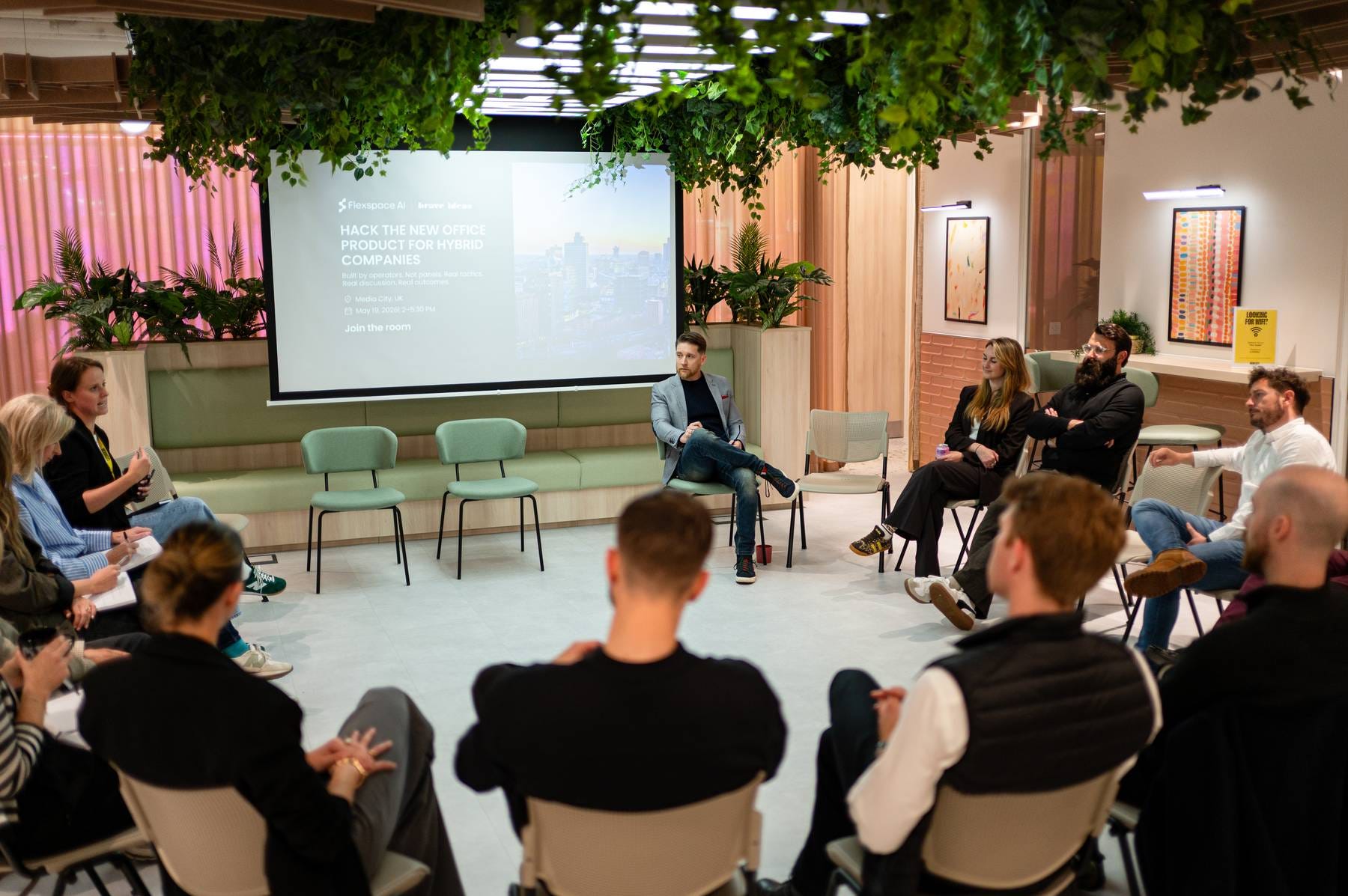
On Tuesday, 19 May, Brave Ideas and Flexspace AI brought together coworking & flex office operators for an intimate round table at at MediaCity in Manchester, UK to discuss one of the biggest questions facing commercial real estate today.
What does the office product need to become in a hybrid world?
The session was co-hosted by Rebekah Lloyd-Beere and James Panepinto.
The room included brands from across the flex and coworking ecosystem, including leaders from:
Koba
Wizu
Halkin
Clockwise
MediaCity
Capital & Centric’s Civic
Colony
Iconic Offices
Consensus
Department
Brave
Level
What made the conversation interesting was not just the agreement around hybrid work changing demand patterns. Most people in the room already accept that reality.
The deeper discussion focused on something more important:
Most office products, leasing structures, and sales processes are still built around pre-hybrid behaviour.
That mismatch is creating problems across the industry.
The Core Challenges Discussed
1. Getting People Into The Building
One of the strongest themes was footfall.
The challenge is no longer simply hitting occupancy targets.
It is creating enough value, energy, and relevance for people to choose to come in consistently.
Hybrid work has fundamentally changed occupancy rhythms.
Tuesdays and Wednesdays are overloaded;
Mondays and Fridays often feel empty.
That uneven usage pattern creates both operational and experiential problems.
Buildings can feel under-energised even when occupancy appears healthy on paper.
And when energy drops, perceived value often drops with it.
2. Companies Want Flexibility, But The Product Often Hasn’t Evolved
Another key topic was how companies increasingly want less permanent space and more optionality.
Many companies no longer need traditional five-day-a-week offices, yet our industry still largely sells fixed products designed around full-time usage.
This has created growing interest in ideas such as:
Fractional offices
Shared team suites
Flexible HQ models
Membership-based workplace access
Dynamic workplace subscriptions
The consensus in the room was that hybrid work is not necessarily shrinking office demand. It is reshaping how companies actually want to buy.
3. Underutilised Space Represents A Revenue Opportunity
A major conversation centered around monetising underused space and amenities, and quieter days.
Instead of viewing slow days and vacancy as dead space, operators discussed how buildings could generate additional revenue through:
Day passes
Event programming
Wellness access
Meeting rooms
Hospitality offerings
Non-member amenity access
Several people discussed the idea that future coworking locations may operate more like hotels, where multiple overlapping revenue streams support the core product.
This is particularly important for hybrid environments where utilisation fluctuates throughout the week.
4. The Coworking Industry Still Struggles To Explain Its Value Clearly
Another honest discussion focused on positioning.
Many coworking and flex brands still describe themselves using nearly identical language:
Community. Flexibility. Hospitality. Amenities. Collaboration.
The topics are not unimportant.
But the issue is that they are no longer enough on their own to create differentiation.
The room discussed how the strongest brands increasingly stand for something more specific.
From Generic Buildings To Location-Based Brands
One of the most compelling ideas discussed was the emergence of location-based brands.
Instead of buildings competing purely on fit-out or location, some operators are creating environments associated with specific industries, communities, or identities.
The idea is that a building becomes known for a particular ecosystem through:
Its member mix
Programming
Events
Partnerships
Marketing
Hospitality experience
Over time, the building itself develops brand gravity.
This creates stronger network effects, better retention, and clearer market positioning.
Several operators noted that this model may become increasingly important as office demand becomes more experience-led rather than purely functional.
Selling Offices Online
Another important conversation centered around distribution.
If the workplace product is becoming more flexible and productised, should the sales process evolve too?
The industry still relies heavily on enquiry-led leasing journeys, lengthy tours, and manual negotiations.
But many modern customers are increasingly comfortable purchasing flexible products online.
That raises important questions:
What products can be booked online?
Can workplace memberships & offices function more like ecommerce products?
How much friction can be removed from the buying process?
The conversation suggested that operators who simplify the customer journey may gain a major competitive advantage.
The Bigger Takeaway
“The big takeaway from yesterday was that ancillary revenue has moved beyond being a supporting act. It is one of the clearest differentiators in flex and one of the strongest routes to revenue growth. The meeting room, the events, the coffee, the day pass, the partnership, these are often the first moments where customers show you what they actually value and pull them to a space. Get those moments right and they do more than generate extra income. They become the funnel into deeper relationships, stickier customers and more fixed products.”
-James Panepinto
The future office market will not be won by space alone.
It will be won by operators who understand how to combine:
Product design
Hospitality
Programming
Community
Technology
Brand
Flexible commercial models
Revenue diversification
And align with how companies and individuals actually behave today.
Hybrid work is not just changing where people work.
It is forcing our industry to rethink what the office product actually is.


