
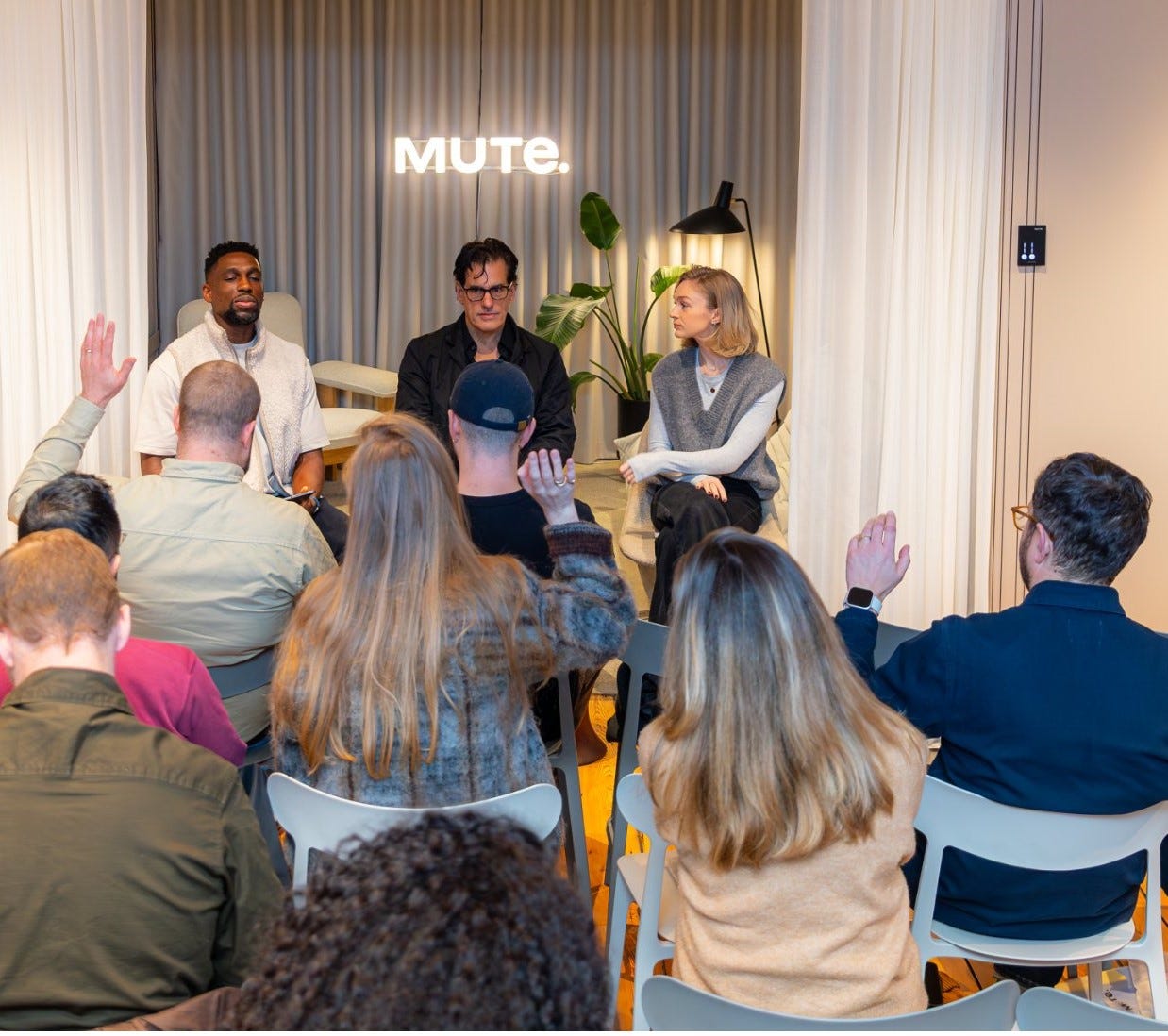
Event Recap: Designing for people, Delivering Profit?
A Brave Ideas x MUTE breakfast panel on how to design flex workplaces for CX + Profit


On Thursday 4 December 2025, Brave Ideas and MUTE brought together flex office operators, landlords, interior designers, architects, and more for a breakfast panel event at the MUTE Showroom in Clerkenwell, London to discuss the new ideas shaping workplaces people want to visit.
How evolving workforce behaviours are reshaping the economics, identity, and purpose of flexible workplace design
Recently, I went to a fantastic event moderated by
with panellists Yorgo Lykouria & Alex Young.The dialogue highlighted how, in Flex, we often focus on beautiful environments, premium amenities, and differentiated brand experiences. Yet behind every design choice sits a commercial model and, more often than not, a desk-per-desk pricing paradigm that has quietly shaped our industry for more than a decade.
This model has helped deliver profitable, scalable workspaces. But it has also created invisible guardrails: capex ceilings that restrict creativity, margin pressures baked into agreements, and a tendency to optimise for density rather than identity.
At the same time, something bigger is happening.
The workforce itself is shifting rapidly.
Behaviours, expectations, and work rhythms are evolving in ways that will redefine what a “workspace” fundamentally is over the next few years.
And for operators, landlords, and designers, the real question becomes:
How do we build spaces that aren’t constrained by the economics of yesterday, but aligned with how people will actually work tomorrow?
Profitability vs. Possibility in Workspace Design
In a market defined by portfolio-wide rollouts and predictable unit economics, the desk remains the basic unit of measurement.
Capex models are built around it.
Fit-out budgets are rationalised by it.
And operators rely on it to benchmark profitability across locations.
Yet this structure introduces certain limitations:
Capex compression tends to reduce design innovation to incremental changes rather than bold differentiation.
Agreements that thin out margins, leaving little room to experiment with experiential design or bespoke elements.
Brand identity becomes harder to express when each space must conform to a uniform cost-per-desk envelope.
The result?
A lot of spaces that are pleasant, even beautiful, but often surprisingly similar.
Brand differentiation is becoming harder at the exact time customer expectations are rising.
And that’s where the workforce changes matter.
The Workforce Shift
The Variable We Can’t Ignore
What sparked my curiosity during our recent industry event was not just how we build spaces, but for whom we’re building them and how that “who” is changing.
Several significant shifts are unfolding:
Hybrid is stabilising, but not standardising. Different teams work in radically different rhythms.
The next generation of workers values choice-shaped environments, calm spaces, social energy, deep focus zones, and wellness-led micro-areas.
Teams are becoming more fluid, creating demand for spaces that adapt in weeks, not years.
The boundary between workspace and brand experience is blurring, making place a strategic storytelling tool.
These changes are rewriting the equation.
If the workforce is no longer desk-bound, why is the industry still pricing, designing, and allocating space as if it were?
Bridging the Gap
From Desk Economics to Human-Centred Value
The challenge and the opportunity are to bridge the gap between commercial models that must remain viable, and design ambitions that reflect a new era of work.
This requires rethinking the fundamental constraints that shape our spaces today.
Imagine if the value of a workspace wasn’t measured solely by how many desks fit inside it, but by:
The diversity of work modes it supports
Its ability to flex without expensive rebuilds
The emotional resonance of the brand in the environment
The quality of experience delivered per square metre, not just the quantity of desks
This is goes beyond aesthetics.
It’s about aligning operational models with human behaviour, something our industry has historically struggled to do at scale or has been reluctant to adapt to.
Looking Ahead: The Next Few Years Will Redefine the Market
As the workforce evolves, several questions will define competitive advantage:
What happens when occupiers demand experience-led pricing rather than desk-led pricing?
How will brands differentiate when workers choose spaces based on identity, culture, and wellbeing?
How do operators balance capex limits with the need to build spaces that are relevant two, five, or seven years from now?
What role will technology and modularity play in creating agile environments that evolve without erosion of margin?
The operators, landlords, and designers who answer these questions first will shape the next generation of flexible workspace because the future of this industry won’t be determined by who builds the most beautiful spaces but by who builds the most adaptive, expressive, behaviour-aligned ones.
What could this industry look like if we designed for emerging behaviours instead of historical metrics?
If we get this right, profitability won’t disappear; it will simply be reframed.


